XAT 2027 Exam Pattern: Complete Section-Wise Breakdown
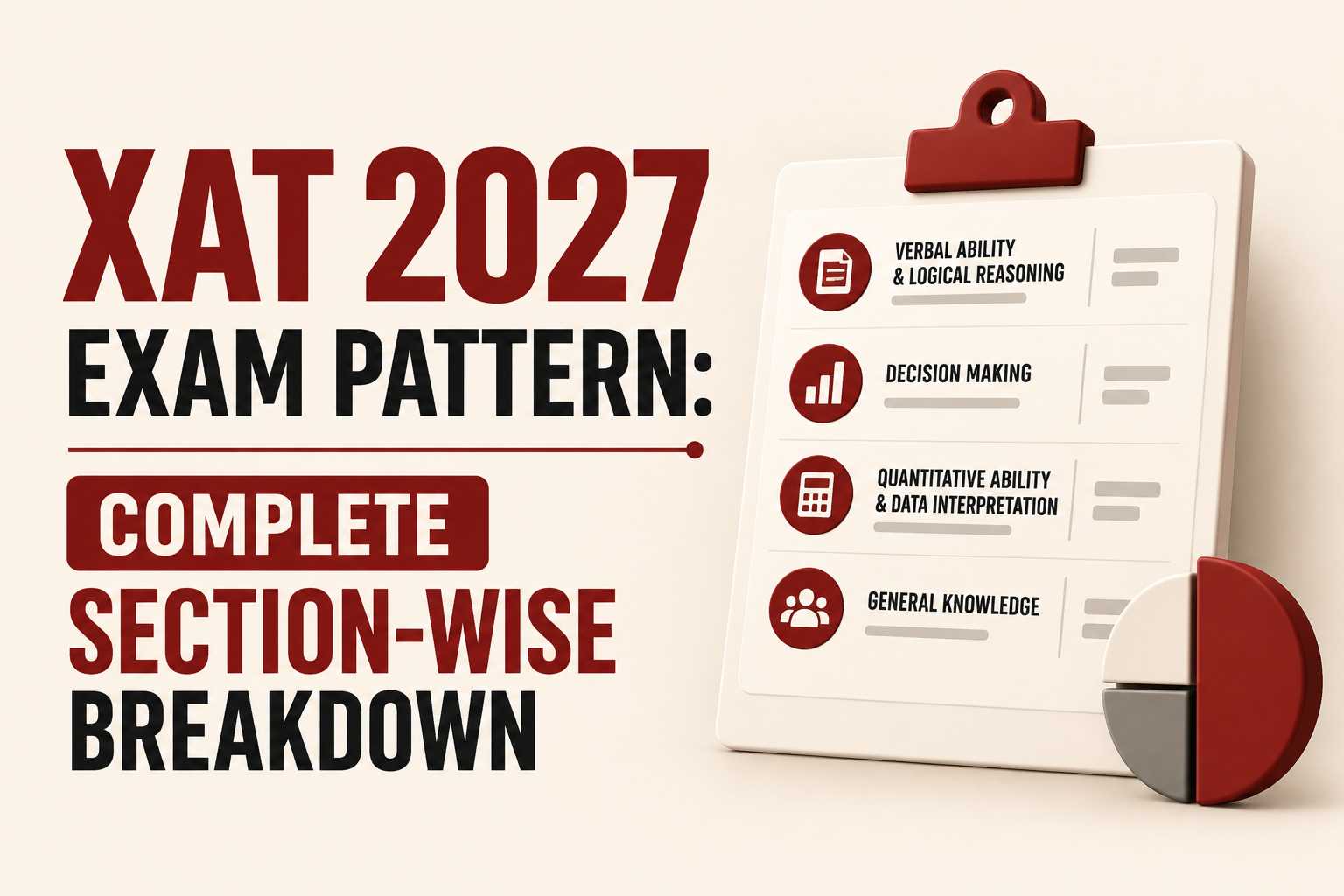
XAT is conducted by XLRI Jamshedpur on behalf of XAMI, and it's genuinely different from CAT and SNAP in ways that matter for how you prepare, not just in section names, but in what specific question formats show up inside those sections. Here's the complete, current pattern, sourced directly from XAT's official information.
XAT 2027 at a Glance
| Details | |
|---|---|
| Conducting Body | XLRI Jamshedpur, on behalf of XAMI |
| Mode | Online (Computer-Based Test) |
| Total Duration | 180 minutes (Part 1: 170 min, Part 2: 10 min) |
| Total Questions | Approximately 95 |
| Total Sections | 3 in Part 1, 1 in Part 2 |
| Accepting Institutes | 250+ B-schools across India |
| PwD Accommodation | Additional 20 minutes per hour |
Part 1: Three Sections, 170 Minutes
Verbal Ability & Logical Reasoning (VALR), ~26 Questions
This is the section where XAT genuinely diverges from CAT and SNAP, and it's worth knowing exactly how.
Reading comprehension in XAT isn't limited to prose passages. It explicitly includes poems and cartoons as comprehension material, alongside standard passages. That's a real, distinctive feature of this exam, most CAT and SNAP prep content, including comparison guides, doesn't mention it clearly, because neither of those exams tests comprehension through poetry or visual cartoons at all.
Beyond that, VALR covers vocabulary, analogies, para-jumbles, grammar-based questions, cloze tests, and critical and analytical reasoning.
Decision Making (DM), ~21 Questions
XAT's signature section, real-world personal and professional scenarios testing ethical judgment, prioritisation, and practical problem-solving. Topics include workplace ethical dilemmas, managerial caselets, business decision scenarios, and situations involving fairness and distribution.
Quantitative Aptitude & Data Interpretation (QADI), ~28 Questions
Arithmetic (percentages, profit and loss, ratio and proportion, time and work, time-speed-distance), Algebra (equations, functions, progressions), Geometry and Mensuration, Modern Math (probability, permutations and combinations), and Data Interpretation requiring genuine analytical reading of graphs, charts, and tables.
Part 2: General Knowledge, 10 Minutes, ~20 Questions
A separate, short GK section, roughly 8 static GK questions and 12 current affairs questions, covering economy, politics, business, sports, awards, science, world events, and the Constitution of India.
This section matters more than its short duration might suggest. XLRI explicitly uses GK scores in final selection, not just as a general shortlisting factor. Since there's no negative marking in this section, the straightforward strategy is to attempt every question, there's genuinely no downside to guessing here.
Marking Scheme
| Correct | Incorrect | Unattempted | |
|---|---|---|---|
| Part 1 (VALR, DM, QADI) | +1 | −0.25 | −0.10 per question beyond the first 8 skipped |
| Part 2 (GK) | +1 | No penalty | No penalty |
The unattempted-question penalty in Part 1 is worth genuinely understanding, you can skip up to 8 questions in Part 1 with no penalty at all, but every skip beyond that costs you 0.10 marks. That makes random guessing on a handful of otherwise-unanswerable questions mathematically sound once you've already skipped 8, rather than leaving them blank.
What Makes XAT's Pattern Genuinely Different
No section order lock, but a real time cost to switching carelessly. You can move between VALR, DM, and QADI within Part 1's 170 minutes, but there's no separate sectional timer forcing a specific pace, which means poor time discipline in one section directly eats into another.
Decision Making is XAT's real differentiator. No other major MBA entrance exam, until SNAP's 2026 EMV section, has tested applied ethical and managerial judgment this directly, and DM has existed on XAT for years, with a real, established body of past questions to learn from.
GK genuinely counts toward selection, not just as a tiebreaker or footnote, which makes it worth real, if minimal, preparation rather than being treated as unimportant background reading.
Preparation Priorities Based on the Actual Pattern
Given VALR's inclusion of poems and cartoons, standard RC practice alone won't fully prepare you for this section, it's worth specifically practising comprehension of non-prose material, since it's genuinely unusual among MBA entrance exams.
Given DM's consistent, sizeable weightage (~21 of 95 questions), and its unique testing of ethical and managerial reasoning, this section rewards structured practice with real caselets far more than generic "read carefully and use common sense" advice.
Given the unattempted-question penalty structure, practising your skip strategy under real timed conditions matters as much as practising the content itself.
Prepare with a Real Structured Approach
Explore XAT 2027 on GRADSKOOL →
Explore XAT Decision Making | The ALP Framework →
Curious how XAT's Decision Making section connects to SNAP's new EMV section? Read our guide: The ALP Framework: Solve Any Ethical Dilemma