The ALP Framework: A 6-Step Method for Solving Any Ethical Dilemma (SNAP & XAT)
Ethical dilemma questions have a specific problem. There's no formula, no fixed syllabus, and often no answer that feels completely right. Two options can both sound reasonable, and picking between them on instinct is a coin flip.
That's exactly the situation SNAP's new Ethics, Morality & Values section puts you in, and it's the same situation XAT's Decision Making section has tested for years. So we built a repeatable process for it. We call it the ALP Framework.
Explore the SNAP EMV Course by GRADSKOOL
This post walks through the full method, with a worked example, so you can use it whether or not you ever take our course.
Why You Need a Framework, Not Just Knowledge
Knowing that honesty matters, or that fairness is important, doesn't help you much when a question presents two options that both honor different values. The real skill being tested in these questions isn't knowledge of ethics. It's structured reasoning under pressure.
A framework gives you a process to lean on when the content itself is unfamiliar. You don't need to have seen the exact scenario before. You need a method that works on any scenario.
The ALP Framework, Step by Step
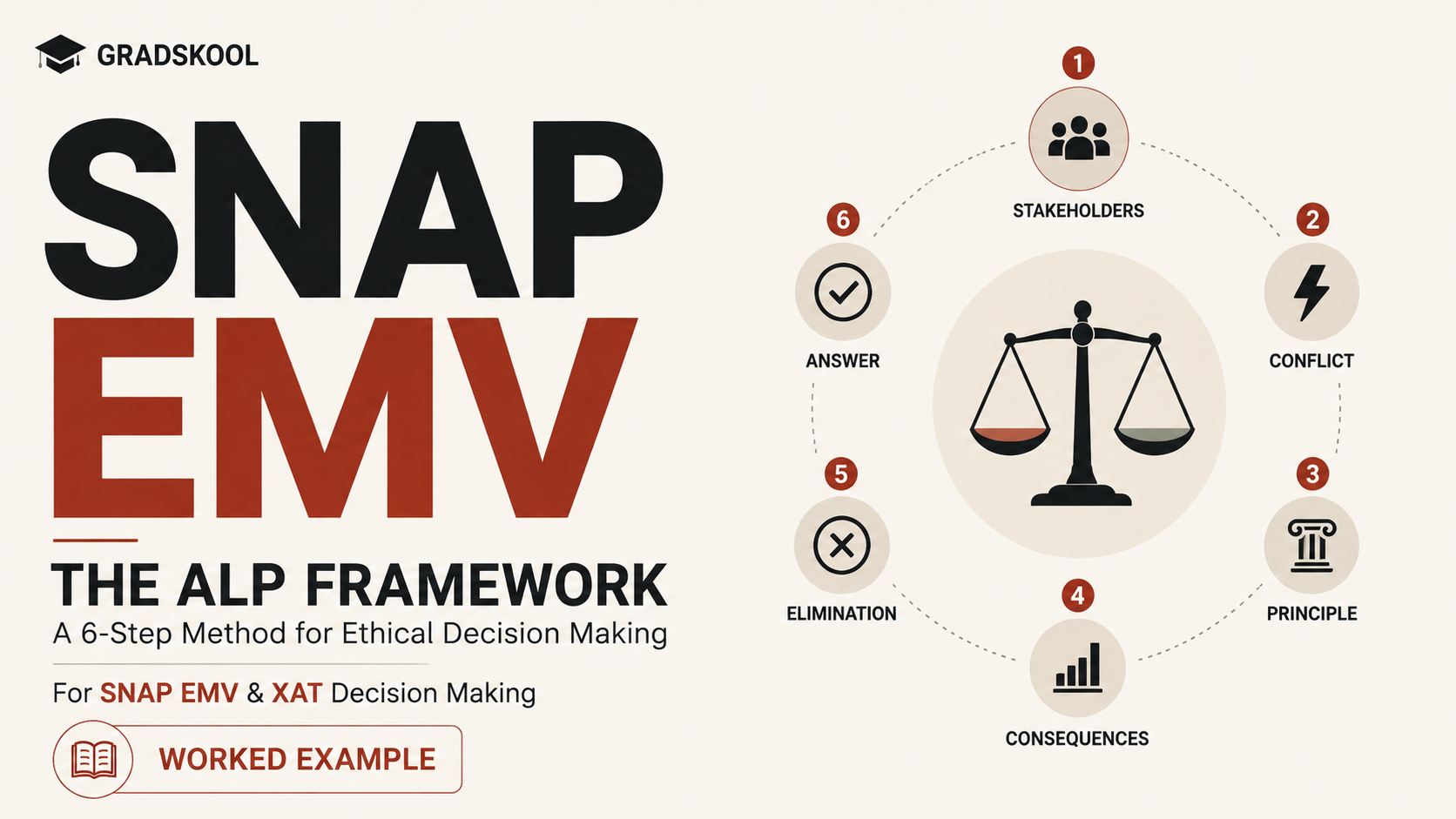
Stakeholders → Conflict → Principle → Consequences → Elimination → Answer
Step 1: Stakeholders
Identify everyone actually affected by the situation. Not just the obvious person in the scenario, but everyone with something at stake, a colleague, a client, an organisation, a broader community. Missing a stakeholder often means missing the actual conflict.
Step 2: Conflict
Name the real tension in plain language. Is it honesty versus loyalty? Individual interest versus collective good? Short-term benefit versus long-term consequence? Getting this step right makes every step after it easier, because you're no longer reacting to the scenario emotionally, you're analysing it structurally.
Step 3: Principle
Decide which ethical principle should carry more weight here, and why. This doesn't require naming a philosophical school. It requires asking, in this specific situation, should the outcome matter most, or should the principle behind the action matter more, regardless of outcome?
Step 4: Consequences
Weigh what happens under each realistic option. Not just the immediate consequence, but the second-order one. What happens if this gets discovered later? What happens to trust, to the relationship, to the people involved, beyond the immediate moment?
Step 5: Elimination
Rule out the options that are clearly indefensible; extreme choices, options that are self-serving dressed up as principled, or answers that sound emotionally satisfying but don't actually hold up to scrutiny. Most ethical dilemma questions have at least one or two options you can eliminate confidently before you even compare the remaining ones.
Step 6: Answer
Choose the most defensible option left, not the most comfortable one. The question usually isn't "what would you personally do." It's "which option is most ethically defensible given the stakeholders, principles, and consequences involved." That reframe matters more than it seems.
The Framework in Action
The situation: A team member privately tells you they made an error in a client report that's already been sent. Fixing it means informing the client and risking the account. Staying quiet means the error probably goes unnoticed, but the client is currently acting on wrong information.
Stakeholders. The client, the team member, your organisation's credibility, and the long-term trust relationship with the client.
Conflict. Loyalty to a colleague versus honesty and the client's right to accurate information.
Principle. Transparency and accountability generally outweigh short-term self-protection, especially in a client-facing relationship built on trust.
Consequences. Disclosing now costs some discomfort and risk to the relationship, but preserves trust long-term. Staying silent risks a much larger breakdown if the client discovers the error independently, and the client continues making decisions on bad information in the meantime.
Elimination. Rule out permanently hiding the error, and rule out publicly blaming the team member instead of addressing the issue constructively.
Answer. Disclose the error to the client promptly, take ownership as a team, and correct the report.
That's the full framework applied to one scenario. The value isn't in memorising this specific answer, it's in seeing how the process gets you there regardless of what the scenario actually is.
Common Traps This Framework Helps You Avoid
Extreme-option traps. Answers that sound decisive but go too far, always report everything to everyone immediately, or never disclose anything under any circumstances, are rarely the most defensible choice. Real ethical reasoning usually lives in a more considered middle ground.
Emotionally attractive but ethically weak options. The option that feels the most comforting to pick, protecting a friend, avoiding conflict, isn't always the option that's actually most defensible once you've run it through Stakeholders, Conflict, and Consequences.
"All options seem right" questions. When every option sounds reasonable on a first read, the Elimination step is what actually breaks the tie. Look for the option that best survives scrutiny across all five earlier steps, not just the one that sounds best in isolation.
"Least unethical" questions. Sometimes every option costs something. In these cases, the answer isn't the option with zero downside, it's the option whose downside is smallest and most defensible given the stakeholders and consequences involved.
Why This Works for XAT Too
XAT's Decision Making section has tested this exact kind of reasoning for years through business and ethical caselets. If you're preparing for both SNAP and XAT, this framework isn't something you need to learn twice. The same six steps apply, whether the exam calls it EMV or Decision Making.
Practising the Framework
Reading about a framework and being able to apply it under a 60-second time limit are different skills. The fastest way to build that speed is repetition, running the same six steps on scenario after scenario until it becomes close to automatic, rather than something you consciously work through question by question.
That's exactly what we built our SNAP 2026 EMV course around, 63 focused lessons, checkpoint quizzes, and a 150+ question bank, all structured around this same framework, so by the time you sit for the real exam, the process feels familiar rather than new.
Explore the SNAP 2026 EMV Course →
Want the full picture of what SNAP's new EMV section covers first? Read our companion guide: SNAP 2026 Ethics, Morality & Values: New EMV Section Decoded